
The Bayeux Tapestry in London: The Story, the Exhibition and How to Make a Weekend of It
See the Bayeux Tapestry in London and discover the museums, history, and culture of Bloomsbury from The Montague.
See the Bayeux Tapestry in London and discover the museums, history, and culture of Bloomsbury from The Montague.
Almost 1,000 years after it was created, one of the medieval world’s most extraordinary surviving works has returned to England.
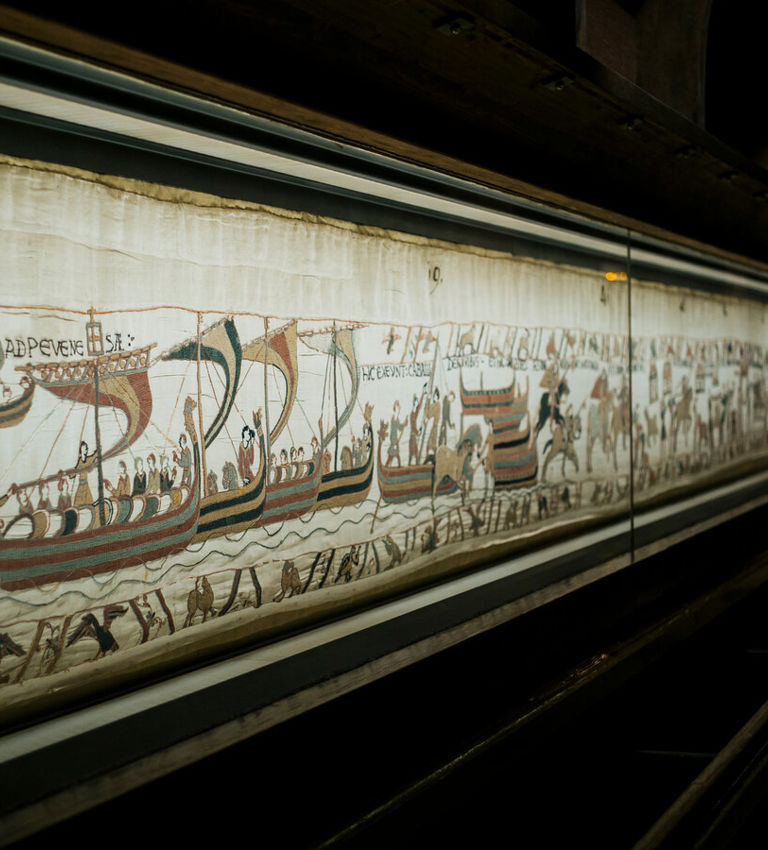
The Bayeux Tapestry is on display at the British Museum from 10th September 2026 until 11th July 2027, giving visitors the rare opportunity to see the original embroidery in London for the first time since it was made. Stretching almost 70 metres, it tells the story of the Norman Conquest through kings and soldiers, ships and horses, feasts, battles and one particularly ominous appearance from Halley’s Comet.
Its arrival also provides a rather good reason to spend more time in Bloomsbury. With the British Museum at its heart, this corner of London brings together centuries of history, literary connections, Georgian squares and cultural institutions, with The Montague on the Gardens just moments from the exhibition.
Despite its name, the Bayeux Tapestry is not technically a tapestry at all. It is an embroidery, created using coloured wool stitched onto linen rather than woven on a loom. Nine separate linen panels were joined to form the work we know today.
Across 58 scenes, more than 600 human figures, around 200 horses, over 40 ships and hundreds of animals tell the events surrounding the Norman Conquest of England. Edward the Confessor, Harold Godwinson and William the Conqueror appear as the story moves towards the invasion of England and the Battle of Hastings in 1066.

The Bayeux Tapestry
Look beyond the battle scenes and it becomes an extraordinary record of medieval life. Clothes, armour, architecture, ships and food all appear within the embroidery, alongside mythical creatures and celestial events. One of its most famous scenes even records the appearance of Halley’s Comet in April 1066, stitched into the sky as an ominous sign watched by fearful figures below.
There is also a mystery at the end. The surviving work stops abruptly with the English fleeing Hastings. William’s coronation on Christmas Day 1066 is nowhere to be seen, leading historians to question if a final section was lost or simply never completed.
One of the most intriguing elements of the tapestry is that a work celebrating a Norman victory may have been created in Anglo-Saxon England.
Scholarship points towards an English workshop, most likely in Canterbury, with the embroidery possibly produced by English craftspeople whose needlework was renowned across medieval Europe.

The British Museum
The British Museum exhibition explores these connections through other medieval objects and documents, offering more context around the people and world depicted in the embroidery.
A charter issued by Edward the Confessor in 1060 includes witness signatures from several figures who later appear in the tapestry. The illustrated Junius II manuscript, created around the year 1000, may have influenced details within the embroidery, including its depictions of ships, clothing and everyday life. The Chew Valley Hoard, meanwhile, contains silver pennies from the reigns of both Harold II and William the Conqueror, taking the story into the aftermath of 1066.
Getting a fragile work almost a millennium old from Normandy to central London was an undertaking in itself.
The tapestry left Bayeux in July 2026 in an operation deliberately kept out of the public eye. It travelled in a bespoke climate-controlled and anti-vibration case, with extensive rehearsals carried out beforehand using a full-scale facsimile to test everything from temperature changes to tight corners along the route.
Its London display is unusual too. The embroidery is shown flat and in one continuous length within a specially designed showcase, giving visitors the chance to take in the scale and sequence of the work in a way that has rarely been possible before. Digital interpretation adds context to the people, symbols and events stitched into its scenes.
The exhibition is held in the Sainsbury Exhibitions Gallery at the British Museum and runs until 11th July 2027.
Tickets operate on a timed-entry system and are being released in instalments, so advance booking is strongly recommended. Adult tickets range from £25 to £33 depending on the date and time selected, while under-16s are admitted free with a paying adult.
Visitors should allow approximately 40 minutes for the Bayeux Tapestry exhibition itself. For anyone keen to see more of the British Museum, it is worth setting aside considerably longer.
Our Concierge team recommends allowing around two-and-a-half to three hours if you would also like to explore some of the permanent collection, and opting for an early morning exhibition slot if availability allows.

The Rosetta Stone
While you are there, make time for some of the Museum’s other great treasures, including the Rosetta Stone, Sutton Hoo collection, Lewis Chessmen, Egyptian galleries and Enlightenment Gallery.
For visitors travelling to London specifically for the exhibition, staying nearby turns the Bayeux Tapestry from a single museum visit into a much richer cultural break.
The Montague on the Gardens sits just moments from the British Museum, within a row of Georgian townhouses overlooking private gardens. From here, much of Bloomsbury can be explored on foot, from Russell Square and Bedford Square to the area’s literary landmarks, museums and academic institutions.

Russell Square
Virginia Woolf and the Bloomsbury Group are closely associated with the neighbourhood, while Charles Dickens lived nearby on Doughty Street. Today his former home houses the Charles Dickens Museum, where visitors can see the rooms in which he lived while working on novels including Oliver Twist and Nicholas Nickleby.
The Foundling Museum offers another side of London history through the story of the Foundling Hospital and its connections with William Hogarth and George Frideric Handel. Sir John Soane’s Museum is also within walking distance, while Covent Garden and the West End are close enough to add theatre or an evening performance to the itinerary.
After a morning with one of history’s great pieces of visual storytelling, return to The Montague for an Afternoon Tea created especially around the exhibition.
The Bayeux Tapestry Afternoon Tea takes its inspiration from the craftsmanship and storytelling of the embroidery, with finger sandwiches, freshly baked scones and pastries served in the hotel’s conservatory overlooking the gardens.

Bayeux Tapestry Afternoon Tea
There is another historical connection here. Anna Maria Russell, 7th Duchess of Bedford, is widely credited with popularising Afternoon Tea in the 1840s. The Russell family has been connected with the Bloomsbury Estate for centuries, while The Montague itself sits within the historic Bedford Estate.
It makes for a particularly fitting way to continue a day centred around Bloomsbury’s history.
For groups of ten or more, The Montague has taken the tapestry’s visual storytelling a step further with two private art experiences.
Bayeux Banquet & Brush combines a charcuterie board and French Martini with a relaxed guided painting session led by resident artist Shelley, inviting guests to create their own work inspired by the tapestry.

Bayeux Banquet & Brush
Tea & Tapestry Sip & Paint pairs the painting experience with the hotel’s Bayeux-inspired Afternoon Tea and Champagne instead.
Both are designed to be social rather than serious art classes, so no previous painting experience is needed. They work particularly well for private groups looking to make more of a British Museum visit rather than simply heading their separate ways afterwards.
A full day at the Museum is also an excellent excuse not to travel far for dinner.
The Blue Door Bistro at The Montague serves AA Rosette-awarded cuisine across both à la carte and table d’hôte menus, with a dedicated children’s menu for younger visitors. Just a short walk from the British Museum, it offers an easy transition from an afternoon exploring the galleries into a relaxed evening over dinner.

The Blue Door Bistro
For drinks before or afterwards, The Leopard Bar has a more intimate mood, with cocktails, wines and light bites accompanied by live jazz in the evenings. It also makes an easy meeting point if friends are convening at The Montague before heading to the exhibition together.
One of the pleasures of staying so close to the British Museum is being able to explore the area at a slower pace.
Begin with an early slot for the Bayeux Tapestry, then spend time with the Museum’s permanent collection before returning to The Montague for Afternoon Tea or lunch.

Jazz nights in The Leopard Bar
Later, walk through Russell Square and Bedford Square, continue towards the Charles Dickens Museum or Sir John Soane’s Museum, then return for dinner at The Blue Door Bistro and drinks with live jazz at The Leopard Bar.
Alternatively, continue south towards Covent Garden and the West End for an evening performance before heading back to Bloomsbury.
The Bayeux Tapestry may provide the reason to book the trip, but there is more than enough in Bloomsbury to fill the rest of a weekend.
A second day leaves time to explore more of the British Museum, discover the neighbourhood’s literary history, browse its bookshops and museums or venture further into central London without having to rush the exhibition itself.
Guests staying at The Montague can also call on the Concierge team for practical advice and recommendations before and during their visit, from museum planning and local discoveries to theatre and dining.
Almost a millennium has passed since the Bayeux Tapestry was last in England. Taking a little extra time to explore the story, and the part of London hosting it, feels entirely appropriate.
Designed for families and multi-generational stays, The Guv’nor’s Suite offers space, comfort, and luxury in the heart of the city.
Discover more
