The Real House of Guinness
Netflix's new hit series, House of Guinness, shines a welcome spotlight on the relationship between Ashford Castle and Ireland's most famous family.
Netflix's new hit series, House of Guinness, shines a welcome spotlight on the relationship between Ashford Castle and Ireland's most famous family.
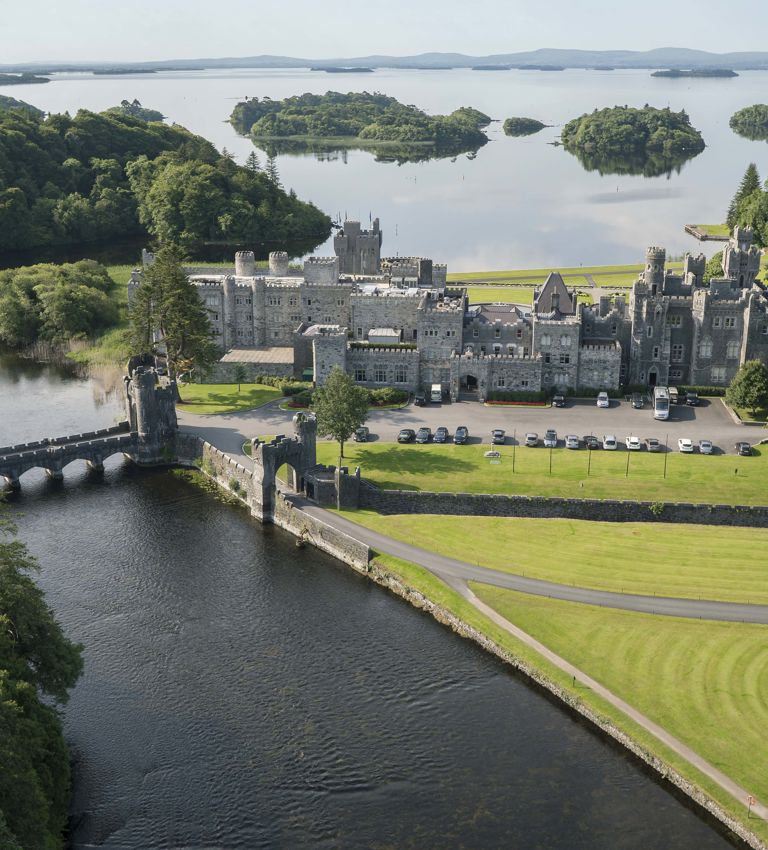
A new historical drama has reignited interest in a family whose name is forever linked with Ireland. Whilst the Ashford Estate was not used as a filming location for Netflix’s House of Guinness, the heavy use of Wales’s Penrhyn Castle as a stand-in illustrates just how integral Ashford Castle is to the Guinness story.
Originally built in 1228 by the Anglo‑Norman de Burgo family, the castle passed through various hands before being purchased in 1852 by Sir Benjamin Lee Guinness, the head of the famed brewing dynasty. He expanded the estate to 26,000 acres, building new roads, planting thousands of trees, and adding two large Victorian‑style extensions. It came to be a grand family seat where he and his descendants entertained guests and showcased their wealth and influence.
Like many aristocratic families of the time, the Guinnesses used Ashford for hunting, fishing, shooting, and entertaining society guests, making it both a home and a symbol of status. The estate’s vast woodlands, Lough Corrib, and surrounding countryside made it ideal for country pursuits, while the castle itself was a showcase of Victorian elegance and hospitality.

Fishing on the estate is an activity still enjoyed today
After his death in 1868, the castle was inherited by his son, Lord Ardilaun, an avid gardener who continued its development, most notably rebuilding the entire west wing and shaping the extensive gardens and woodlands. Together, their vision not only preserved Ashford’s medieval character but also infused it with the refined hospitality and stately presence for which it has since become world‑renowned.
In the era of Lord Ardilaun, the vision for the estate was particularly ambitious. He planted in excess of 10,000 acres of forest, not merely for show, but to create grand walks, cover for game birds, and to sustain employment for local communities long after the famine. Among the specimen trees introduced were Californian redwoods, Holm oaks, and even a Cork oak. The expanding belts of woodland became woven through the riverine and hillside context of the estate. The Guinesses also built the pier at Lisloughrey (which can be seen from The Lodge) primarily to service their yachts and sailing craft. Subsequently they commissioned a steamboat service from Lisloughrey to Galway several times weekly, both to bring supplies into the estate and to deliver goods to merchants around Lough Corrib. The Lodge itself served as the gamekeeper’s house for the Guinness family, overseeing the country pursuits across the demesne.
One particular space in the castle still evokes the elegance of the Guinness era: the Connaught Room. This was once the Drawing Room to the Guinness family, where Lord and Lady Ardilaun entertained with tea and light refreshments. Today, that tradition continues, as The Connaught Room hosts Afternoon Tea, served amid views of garden and lake, in a setting that honours its genteel past. It was here that guests such as Oscar Wilde, George Bernard Shaw, and other luminaries would have been welcomed.

The Connaught Room
Over time, the maintenance of such a vast estate, along with changing social and political currents in Ireland, made it increasingly impractical to keep Ashford Castle as a private residence. After Lord Ardilaun’s death in 1915, the property passed to his nephew Ernest Guinness. In 1939, the estate was sold and its life as a luxury hotel began. Since then, each successive proprietor has balanced restoration, innovation and preservation. Among the more recent chapters: John Mulcahy’s restoration and expansion in the 1970s; investments in the 1980s by a consortium that included Irish‑American backers and the family of Tony O’Reilly; and, in 2013, Red Carnation Hotels acquired Ashford and launched a careful restoration programme that revitalised stonework, interiors, gardens, and windows.
Though House of Guinness may dramatise family rivalries, inheritances, and the broader sweep of 19th‑century Ireland, the echoes of what the Guinness family accomplished here at Ashford persist in every room, lane, woodland, and vista. When guests stroll across the moat, wander beneath specimen trees, climb to the turrets or sip tea in the Connaught Room, they tread in a living memory, one that honours medieval roots, Victorian ambition, and the legacy of a family who for a time made Ashford their own country stage.
Discover each of our the 83 rooms, suites and The Boathouse at Ashford Castle, which represent traditional elegance and finesse.
Discover more